Impact resistant shingles are usually worth considering in Kansas City if your roof is being replaced anyway, your home sees frequent hail exposure, and your insurer offers a verified discount. Class 4 shingles have the highest UL impact rating, but they are not hail-proof. Ask for the product rating, warranty terms, upgrade cost, and insurance documentation before you sign.
Kansas City homeowners do not need a lecture on hail. One spring storm can leave dents on vents, bruised shingles, granules in gutters, and neighbors suddenly comparing roof bids in the driveway. Impact resistant shingles are one way to reduce that risk, but the details matter.
What are impact resistant shingles?
Impact resistant shingles are asphalt shingles designed to absorb more hail impact than standard shingles. Most homeowners are comparing Class 3 and Class 4 shingles, with Class 4 being the highest impact rating under the UL 2218 test.
GAF explains that Class 4 shingles are tested by dropping a 2-inch steel ball from 20 feet onto a shingle test deck. The test allows cosmetic dents, but the shingle should not crack through. Class 3 uses a smaller 1.75-inch steel ball from 17 feet.
That does not mean a Class 4 roof is immune to hail. It means the product passed a lab test that standard shingles may not pass. Large hail, wind-driven impact, age, poor ventilation, bad installation, and roof pitch can still affect performance.
Are Class 4 shingles worth it in Kansas City?
Class 4 shingles can be worth it in Kansas City when the upgrade cost is reasonable and the homeowner values stronger hail resistance, longer product performance, and possible insurance savings. They make the most sense on homes that already need roof replacement, not as a cosmetic upsell on a roof with useful life left.
Use this quick filter:
| Homeowner situation | Impact resistant upgrade read |
|---|---|
| You plan to stay in the home for years | Stronger case for Class 4 |
| You are replacing the roof after hail anyway | Good time to price the upgrade |
| Your carrier offers a discount with proof | Worth calculating payback |
| You plan to sell soon | Ask whether warranty transfer helps resale |
| Your roof is repairable and young | Replacement just for the upgrade may not pencil |
Maverick has seen real estimate examples where moving from a Class 3 hail resistant shingle to a Class 4 option changed the project by roughly a couple thousand dollars on that specific roof. That is not a universal price. Roof size, product line, accessories, pitch, and warranty package can swing the number fast.
For a broader roof replacement budget, start with Roof Replacement Cost in Overland Park or the 2026 Kansas City roof replacement cost guide. Pricing should be based on measured roof area, not house square footage.
What is the difference between Class 3 and Class 4 shingles?
Class 3 and Class 4 shingles differ by impact test level, product construction, and often warranty package. Class 4 products are usually built with more flexible asphalt technology so the shingle can absorb impact without cracking as easily.
A simple way to think about it:
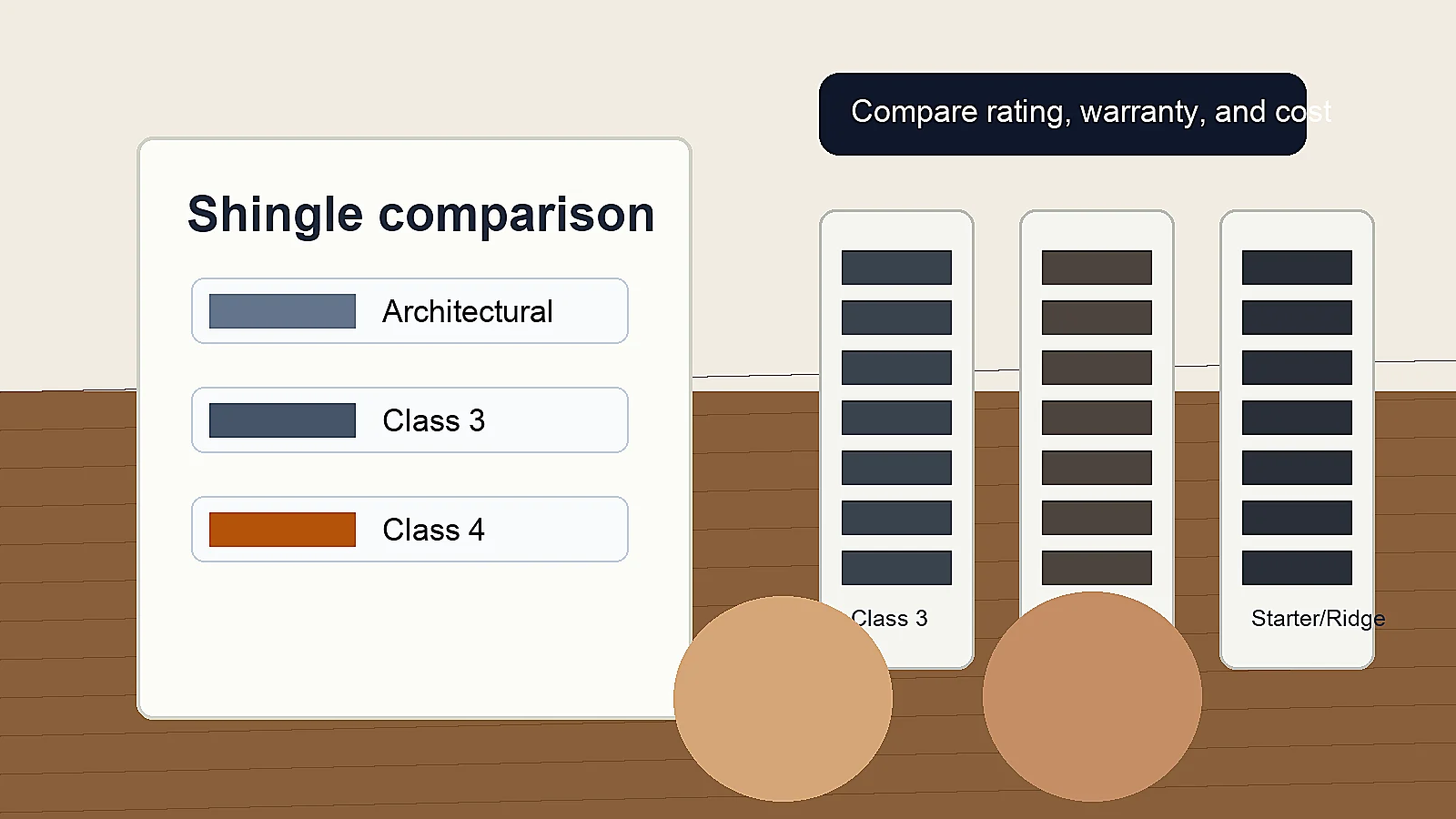
- Class 3 shingles: Better impact resistance than standard architectural shingles, but not the top impact rating.
- Class 4 shingles: Highest UL 2218 impact rating, often the option insurers ask about for premium discounts.
- Standard architectural shingles: Common roof replacement choice, but may not carry the same hail impact rating.
The product name matters too. Do not accept “hail resistant” as a vague phrase. Ask for the manufacturer, product line, impact rating, warranty registration, and whether the full roof system uses matching manufacturer components.
Can impact resistant shingles lower insurance premiums?
Some homeowners insurance companies may offer discounts for Class 4 impact resistant shingles. The discount is not guaranteed, and it varies by carrier, state, policy, roof age, documentation rules, and product approval. Ask your insurance agent before the roof is installed, not after.
A safe sequence looks like this:
- Ask your agent whether your policy offers an impact resistant roofing discount.
- Ask which rating or product documentation they require.
- Confirm whether the discount applies to the full premium or only part of the wind and hail portion.
- Keep the shingle invoice, product data sheet, and contractor documentation.
- Submit documentation to the carrier after installation if the policy allows it.
Maverick can provide construction documentation for the roof system installed. The insurer decides whether a discount applies, how much it is, and whether the policy has any cosmetic damage exclusions tied to that discount.
What should Kansas City homeowners ask before choosing impact resistant shingles?
Before paying for the upgrade, ask questions that separate a real roof system from a sales pitch.
What exact shingle is being installed?
Get the manufacturer, product line, color, impact rating, and warranty package in writing. If the estimate only says “Class 4 roof,” it is not specific enough.
Is the whole roof system built for the warranty?
Some upgraded warranties depend on using manufacturer-approved components, not just the field shingles. Ask about starter shingles, ridge cap, underlayment, ice and water shield, ventilation, flashing, and registration steps.
How much is the upgrade on this roof?
Do not rely on a generic percentage. A steep roof in Leawood, a ranch in Olathe, and a complex roof in Kansas City, MO can price differently. Ask for the base option and the impact resistant option side by side.
Does the warranty cover hail damage?
Many manufacturer warranties have limits around impact, hail, cosmetic damage, or acts of nature. GAF notes that UL 2218 testing is done under controlled conditions and that hail damage is not covered under GAF limited warranties. Read the actual product warranty before treating a rating like a promise.
Will my insurance policy treat cosmetic damage differently?
Some policies and discounts may involve cosmetic damage language. Ask your agent what changes, if anything, when an impact resistant roof is added. This is an insurance policy question, not a contractor decision.
How should impact resistant shingles fit into a storm claim?
Impact resistant shingles can be discussed during a storm-related roof replacement, but coverage decisions belong to the carrier and policy. A contractor should not promise that insurance will pay for an upgrade.
Maverick keeps the role construction-focused:
- Inspect the roof and document observed damage.
- Explain the roof construction scope and product options.
- Compare roof-system line items so the homeowner understands what is included.
- Meet an adjuster when appropriate and requested.
- Submit construction documentation for carrier review.
- Perform approved work after the homeowner chooses the scope.
If you are comparing a carrier estimate, a contractor estimate, and an upgraded shingle option, read Roofing Estimate Missing Line Items before signing. The shingle line is only one part of a roof system.
When should you skip the upgrade?
Skip or pause the upgrade conversation if the roof does not need replacement, the product documentation is vague, the contractor cannot explain the warranty, or the insurance discount math does not help. A better shingle on a sloppy install is still a sloppy roof.
The basics still matter:
- Proper tear-off and decking review
- Correct underlayment and ice barrier placement
- Flashing and penetration details
- Ventilation balance
- Manufacturer-specific starter and ridge components
- Cleanup, magnet sweep, and written warranty terms
If those pieces are missing, Class 4 shingles become expensive decoration. Very sturdy decoration, sure. Still decoration.
Frequently Asked Questions
Are impact resistant shingles hail-proof?
No. Impact resistant shingles are not hail-proof. A Class 4 rating means the shingle passed the highest UL 2218 impact test under lab conditions. Severe hail, older shingles, poor installation, high wind, and roof design can still lead to damage.
What is a Class 4 shingle?
A Class 4 shingle is a roofing shingle that passed the highest level of the UL 2218 impact resistance test. The common shorthand is a 2-inch steel ball dropped from 20 feet without cracking through the shingle test deck.
Do Class 4 shingles always lower insurance premiums?
No. Some carriers offer discounts, but they are not automatic. The amount and rules vary by insurer and policy. Ask your agent before installation and keep written product and installation documentation.
How much more do impact resistant shingles cost?
The upgrade cost depends on roof size, shingle line, roof complexity, accessory materials, warranty package, and labor. Ask for a side-by-side estimate with the standard option and the Class 4 option so you can compare the real difference on your roof.
Are impact resistant shingles better for resale?
They can help the conversation, especially in hail-prone areas, but resale value depends on buyer priorities, warranty transfer rules, roof age, and documentation. If resale matters, ask whether the manufacturer warranty can transfer to the next homeowner.
Should I choose Class 3 or Class 4 shingles?
Choose based on your hail exposure, budget, insurance discount, warranty goals, and how long you plan to keep the home. Class 4 is the stronger impact rating, but Class 3 may be enough for some homeowners if the budget or payback does not support the upgrade.
Get a straight shingle comparison before you replace the roof
If you are replacing a roof in Kansas City, ask for the standard architectural option, the Class 3 option, and the Class 4 option in writing. Then compare the full roof system, not just the shingle name.
Maverick Exteriors can inspect the roof, explain material options, document the construction scope, and help you compare impact resistant shingles without turning the estimate into a magic trick. Start with a free roof estimate or review residential roofing services if you are still deciding between repair and replacement.